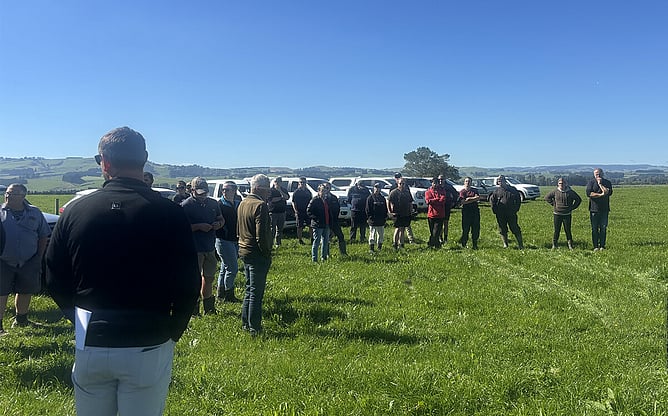
In March, the Group partnered with DairyNZ to revisit the case study farms and share what has been learnt across the catchment.
Last year focused on what happens when different nitrogen mitigations are stacked together. This year, we dug deeper into what is driving results on farm, with a strong focus on plantain and system decisions. With more than 60 farmers attending, the discussion was grounded in a wet spring and the real time decisions that followed.

Birgit Pemberton using the Cow Bell to move everyone along!
At a farm level, the modelling continues to point in a clear direction. Shifting nitrogen fertiliser away from autumn and winter, and making earlier culling decisions, reduces risk at key times with minimal cost. Plantain at around 10 percent in ryegrass pastures can reduce losses by about 7 percent, and lifting this further can increase the benefit with but has a small impact on profit. Bigger system changes can achieve more, but come with greater trade-offs. These system changes have been modelled previously, and can be found on the Edendale Aquifer Group’s webpage https://www.thrivingsouthland.co.nz/edendale-aquifer-group/
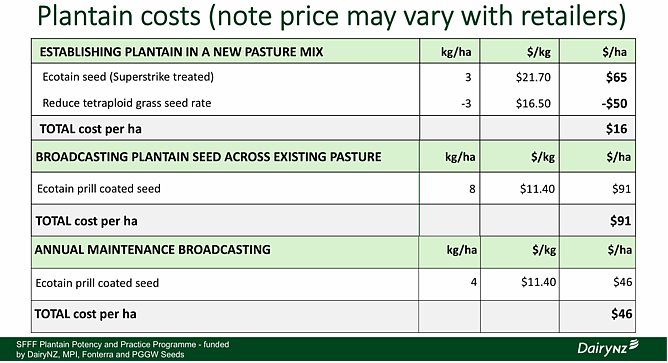
There was also a strong focus on the practical cost of getting plantain into the system. Establishing plantain through a new pasture mix is one of the lower cost options, sitting at around $16 per hectare once reduced grass seed rates are accounted for. Broadcasting plantain across existing pasture comes at a higher upfront cost, closer to $91 per hectare, with ongoing maintenance broadcasting sits around $46 per hectare each year. These figures helped ground the conversation in what different approaches look like in practise, and where they may fit within different farm systems.
Looking across the case study farms, a few patterns are emerging. Where nitrogen fertiliser use and imported feed increased, nitrogen losses also tended to rise. Where plantain was established, fertiliser timing improved, or more use was made of stand-off areas or barns in high risk periods, losses reduced.
On one study farm, steady plantain establishment and lower nitrogen inputs are helping hold losses steady, showing the value of consistency over time. At another modelled farm, lifting the plantain percentage in the pasture, and shifting fertiliser timing is helping reduce losses even with higher inputs. Notably, this farm has achieved about 17 percent plantain in their pasture, which is significantly higher than other farms in the study. This has been achieved through broadcasting seed and a strong focus on detail, particularly ensuring good seed to soil contact to support establishment. On two of the other study farms, the wet season placed added pressure on systems, with higher inputs and supplement use contributing to increased losses and underscoring how quickly progress can be challenged under difficult conditions. Our fourth study farm made a move toward more intensive inputs, and has lifted both production and risk, while changes planned around plantain and system design aim to rebalance this. At our last study farm, , a wet year drove higher inputs, but infrastructure like feed pads and wetlands are being used to better manage risk moving forward.
Results are being driven by a mix of pasture composition, fertiliser decisions, feed, and infrastructure, all influenced by the season. Together, these insights highlight that small, well managed changes across multiple areas can deliver meaningful reductions in nitrogen loss while maintaining farm performance.